
Guidelines.com serves more than one million healthcare professionals annually, connecting them to 3,000+ clinical guidelines from over 50 medical societies, thousands of drug monographs, and extensive libraries of clinical trials and medical literature.
The team had decided its future was AI. They brought in GoInvo to define what that meant for the product: how clinicians would use it, how the evidence would connect, and how the experience could preserve twenty years of clinical trust.
In four weeks, we translated that ambition into a product strategy, an AI trust model, and interactive prototypes.
Five evidence systems. One clinical question.
Guidelines, medications, trials, PubMed, and calculators occupied separate sections, each with its own search, filters, and workflows. A clinician considering anticoagulation for a 78-year-old with new-onset atrial fibrillation had to decide where to look, search across multiple sources, and connect the evidence.
The opportunity was bigger than a new search interface. It was to organize the product around the clinician’s question.
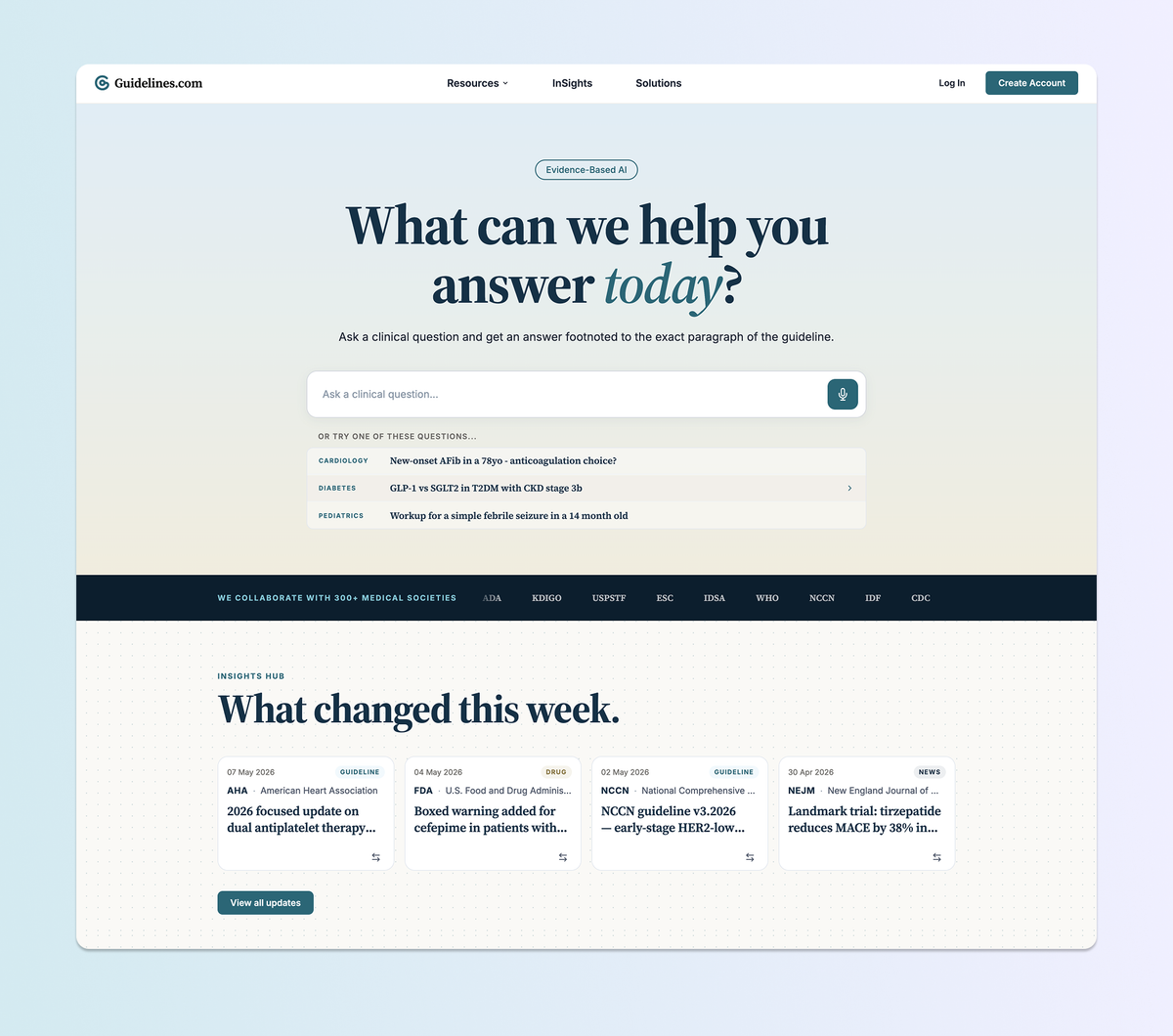
We designed an experience that brings the relevant evidence into one clinical workflow.
The trust model came before the interface.
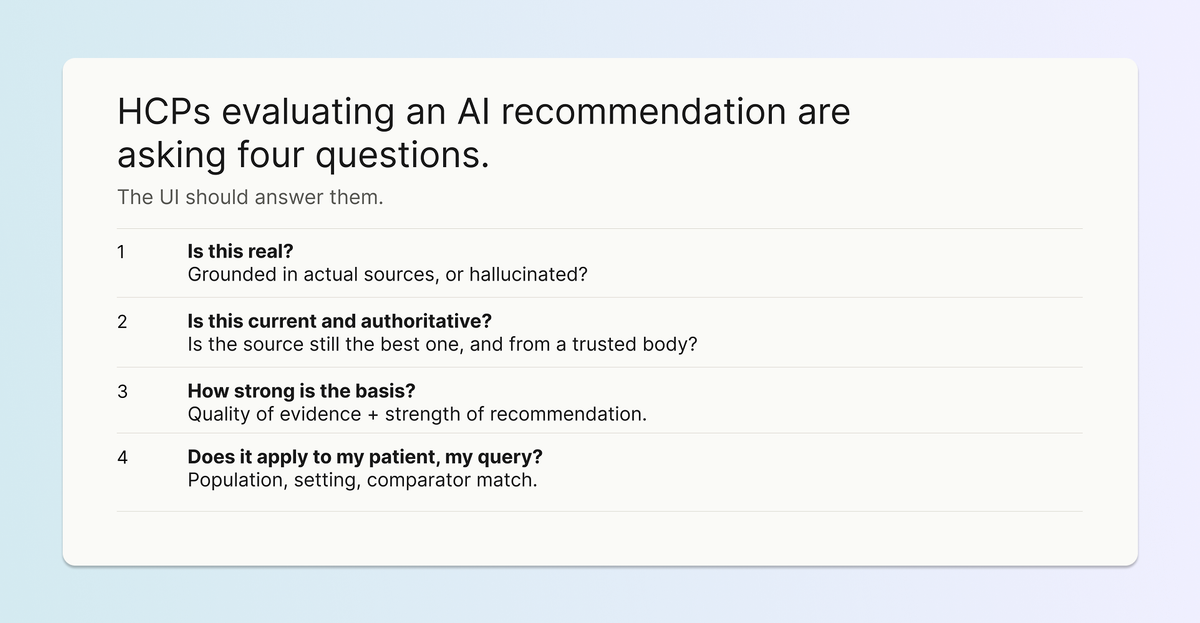
A convincing answer is not enough in clinical care.
What happens when medical societies disagree? When evidence is weak? When patient context is missing? When no supported recommendation exists?
Before designing the answer screens, we defined how the product should respond.
- When evidence supports a recommendation: show the recommendation and its sources.
- When societies disagree: expose the conflict and show both positions.
- When evidence is limited: make the limits visible.
- When patient context is missing: ask a clarifying question.
- When no supported recommendation exists: say so.
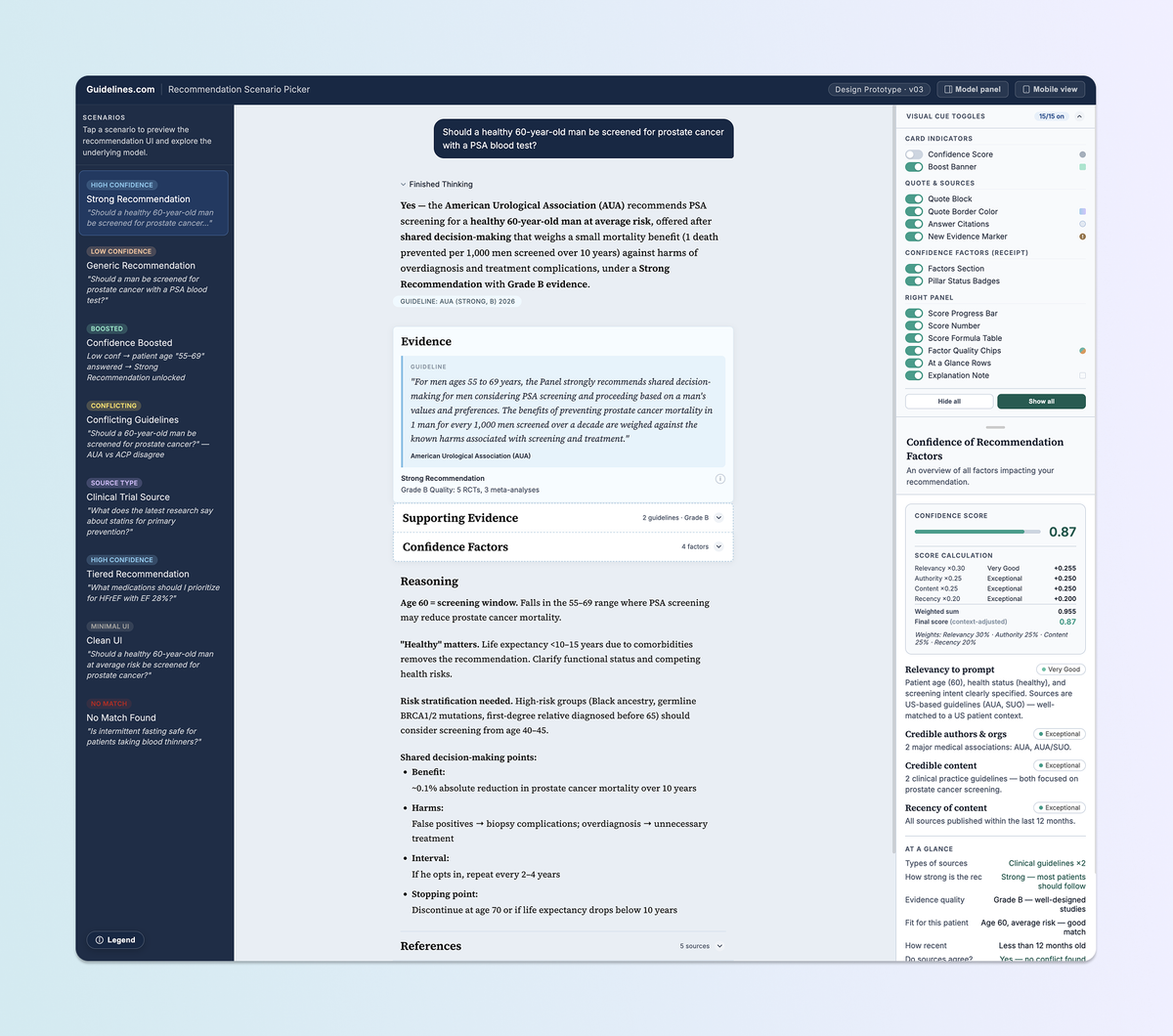
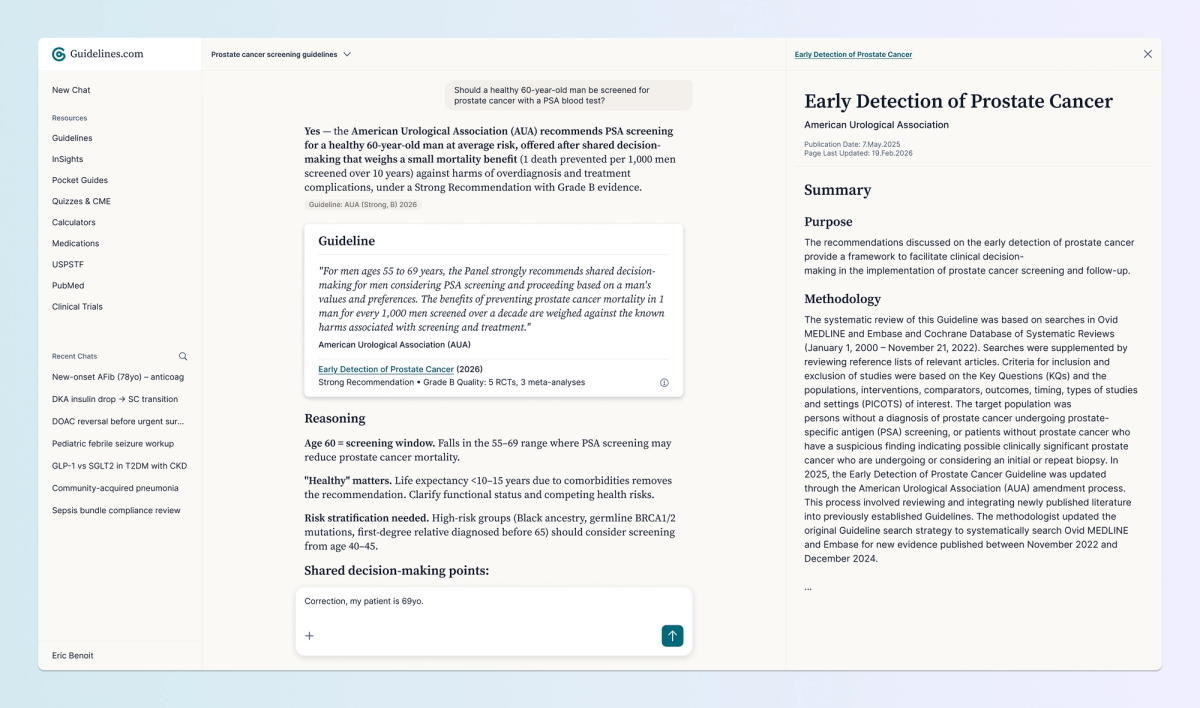
Every recommendation needed a path back to its evidence, down to the source section or paragraph.
We designed the rules governing the answers, then made those rules visible in the experience.
Product decisions that made the strategy tangible.
One question connects the evidence.
The prototypes brought guidelines, drug information, trials, and medical literature into a shared answer experience, with a consistent citation format. Clinicians could follow the evidence without repeatedly switching search tools.
Chat and browsing work together.
AI became the primary entry point, while browsing remained a first-class path. Clinicians could choose how they explored the content and how much of the screen the assistant occupied.
Sources stay close to the recommendation.
Citations, disagreements, and uncertainty were part of the answer itself. The design gave clinicians a way to inspect the basis for a recommendation before acting on it.
Four weeks to a concrete product direction
- We worked across product strategy, clinical research, interaction design, and implementation planning.
We audited the existing product and roadmap, mapped seven competing services, and interviewed three clinicians about how they use, or choose not to use, AI in clinical care.
That work informed a recommendation-scenario tool and several interactive prototypes, spanning the landing page, clinical answer experience, and mobile assistant. A shared component layer and Figma-synced design tokens established a consistent foundation for future implementation.
The prototypes made the proposed behavior concrete enough to inspect, discuss, and refine. The clinician interviews informed the direction; clinical validation remained a next step.
A product strategy built around clinical trust.
The engagement gave Guidelines.com a specific direction for its AI investment: help clinicians ask one question across its evidence library, inspect the sources behind an answer, and understand when the evidence cannot support a clear recommendation.
The client left with a trust model, interactive prototypes, and a shared design foundation to guide implementation.
GoInvo connected the strategic question, what should we build?, to the product decisions that determine how it should work.
Get in touch
or email us at info@goinvo.com
Authors

Chloe Ma, GoInvo
Chloe is a designer and researcher specializing in medical and scientific storytelling. She drives to improve healthcare equity, education, and accessibility through good design. Chloe joined Invo in 2021 with a BS in BioChemistry and Molecular Biology from Dalhousie University and a MSc in Biomedical Communication from University of Toronto.

Eric Benoit, GoInvo
Eric Benoit is the Creative Director of GoInvo, leading the studio’s UX creation process from concept to production. Eric works as an interaction designer, experience designer, and information architect, designing better products by thoroughly understanding user behaviors, expectations, and goals. Eric’s background and love for design in the context of human experience helps him transform complex information systems in healthcare and the enterprise into responsive and adaptive human-centered designs.

Juhan Sonin, GoInvo
Juhan Sonin leads GoInvo with expertise in healthcare design and system engineering. He’s spent time at Apple, the National Center for Supercomputing Applications (NCSA), and MITRE. His work has been recognized by the New York Times, BBC, and National Public Radio (NPR) and published in The Journal of Participatory Medicine and The Lancet. He currently lectures on design and engineering at MIT.