
Loneliness in our Human Code
Among social determinants of health, loneliness can hugely impact a person’s mental state, physical health, and overall wellbeing. In this brief, we explore how social determinants of health, with a focus on loneliness, affect health over the course of a lifespan, taking into consideration the unique circumstances and needs at each stage of life.
Social isolation costs us...
When we feel excluded, we lose our fight against disease.
It increases our risk for3,4



It increases impacts for our body's functions4,5,6,7


It's not just a feeling.
Loneliness...
Is a co-morbidity
We feel lonely when our current number of social relations (and the quality of those) do not match what we desire. This feeling can lead to a loss of our sense of belongingness, satisfaction with life, and is associated with the onset of co-occuring physical and mental illnesses.8,18
Manifests as physical pain
A broken heart exhibits similar physical pain levels as a broken limb because our nervous system processes social rejection in the same area of the brain as physical pain. Evolution has wired socialization into the brain’s automatic reflexes on account of human contact dramatically increasing our chances of survival.14,15
Is a dysfunction of the brain
The default for the human brain is to assess and respond to our social context and stimuli, otherwise known as our “default network". When we feel socially fulfilled, there is a boost in our brain’s reward center (activating dopamine and oxytocin) along with healthy function in the parts of our brain that process social exclusion.11,12,13
Can affect gene expression
Studies have found that there may be genomic and hereditary indicators for loneliness, including a study of older people that found 209 abnormally expressed genes in their lonely group. In the lonely people, genes in charge of activating inflammation were over-expressed while those regulating antiviral and antibody mechanisms were under-expressed.6,9,10
The causes and consequences are unique to every person.
Take a look at how social connection varies across our lifespan
Infants

Early nurture
Social connectedness begins when life begins, and is most impacted by the quality of early relationships with parents and caregivers. Close family ties including grandparents, siblings, aunts, and uncles can start building an infant's social support system by spending time with them in these formative years.16

Physical closeness
Physical attachment is crucial for infants, and separation can cause high levels of anxiety. One study showed that tending to and cuddling hospitalized infants can increase survival rate by 20%, despite the risks of infection.16,17

Neighborhood conditions
Infants who grow up in a stable neighborhood environment have an increased ability to develop strong social networks.18,19,20
Children

Effects of poverty
Living in a diverse environment allows children to make social connections that open them up for stronger support systems that will grow over time. Poverty serves as a barrier to social, physical, emotional, educational, and economic resources since the poorest communities have historically been and continue to be highly segregated.16,21

Parents
Parents and guardians play a huge role in children's overall wellbeing. Growing up with both parents present and engaged in their child's life doubles the likelihood and increases the adequacy of access to emotional, physical, and educational support.16,21

Speech and language
Speech and language are the two most important aspects of early childhood development, and the foundations of social and emotional well-being. Parents and guardians can help with this by spending time with children, including making and having meals, reading, and playing sports.16
Adolescents

Sleep
People who report getting enough sleep are 70-80% less likely to feel a lack of companionship. While this is true for all ages, adolescents are particularly at risk with a decreased production of melatonin (sleep hormone) compared to that of young children. Additionally, use of electronic devices late into the night have been found to impair sleep.23,24
Parent-child relationship
The relationship between a parent and child is crucial to lifelong health and well-being. In fact, having a strong connection with a father figure decreases the likelihood by 68% of consuming alcohol, tobacco products, and drugs in their teenage years, and are less likely to participate in juvenile delinquency. Religious, community, big brother, and big sister programs, as well as supportive educators are key at this stage to fill any gaps that exist in a child's support system.22

Peer influence
A major component of adolescent growth is gaining independence and a sense of identity. Often, this leads to conflict with parents and a tendency to turn to peers for guidance and support. However, at this time, adolescents can be susceptible to peers who exert negative influence. Finding a peer group that exerts positive influences leads to building a strong support system.16,25
Emerging Adults

A time of change
Emerging adulthood is a time of exploration and change, including testing different careers, values, relationships, and geographic residences that may mean leaving family for the first time. This change is often characterized by the constant forming, breaking, and reforming of social bonds. This is why having a constant source of social support can have major impacts on health and life satisfaction. In fact, if a person has a friend they see on most days, it has a similar impact on life satisfaction as would earning an extra $100,00 of income.14,16

Healthy behaviors
A feeling of connectedness and belonging is correlated with a host of healthy behaviors including exercise, a wholesome diet, and safe sex. Supporting your body strengthens your mind and increases your ability to emotionally connect with others.26
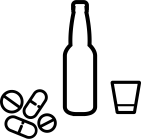
Substance use
Many emerging adults value peer opinions and actions as guidance for their own. During this time, individuals may experiment with alcohol and drugs as part of socializing. Males disproportionately consider drinking-related activities as a way to foster intimacy and closeness with peers, while females rely more on self-disclosure or sharing multiple activities.26,27
Adults
Heart health
Maintaining cardiovascular health is extremely important for people of all ages, but poor health outcomes are particularly risky for both adults and seniors. Loneliness is associated with all types of heart disease, including ischemic heart disease, arrhythmia, heart failure, and heart valve disease. Among those with coronary artery disease, the lonely are two times more at risk of cardiac death.28,29

Self-preservation
Lonely people focus more on self-preservation and become more defensive in the face of their environments. As a survival mechanism, the brain is wired to focus on the self instead of caring for those around. Unfortunately for the person, this can backfire and make themselves even more unpleasant to be around, leading to more and more negative social encounters and fewer people willing to be around them.30

Social loss
Because many people identify themselves in terms of their relationships, losing a spouse or friend to distance or death can be a very painful experience, both emotional and physical. While the likelihood of losing someone is equal across age groups, many adults see some of their friendships weaken as a product of building a family or experience the passing of a parent or spouse. In terms of life satisfaction, when we break a social tie, it is similar to suffering $90,000 loss in annual income.14,31
Aging adults

Companionship
Aging adults are most lonely when they are not involved in activities that build social connections such as volunteering, religious services, family time, or other community participation. In fact, 40% of seniors report television as their main companion. While technology such as the internet and television can be a helpful tool to alleviate isolation, contact with other humans brings the most fulfillment.16,32

The home
Being able to maintain one’s own home promotes confidence and well-being in older people. Not only does it offer a sense of control and contribution, but a level of independence strengthened by opportunities to stay active and gather with friends in their community.32
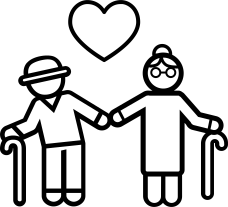
Long term partner
Many people live with a long-term partner into old age, and a large majority of people rely on their partners as a primary source of social support. However, aging can bring unexpected medical events and even death, leaving the healthy or surviving partner to suffer harmful effects to mental and physical health. Additionally, the percent of widows living with a child has decreased significantly in the last 100 years: from 70% to 20%. This means that aging adults who have lost their spouse are much more likely to live alone than with family.16,33
Resilience in Our Human Code
While these are statistically relevant, humans have the ability to survive and surpass their circumstances to live full and healthy lives. Loneliness, and other social, circumstantial, and behavioral determinants have as much impact on your health as your biology or genetics. If you or someone you know is feeling lonely, check out resources in your neighborhood or reach out to talk to someone. Sometimes a little bit of human contact can go a long way towards living a healthier life.
Take Steps Now34
- The National Alliance on Mental Health provides education, outreach, and advocacy and support services. Call the NAMI helpline 800-950-NAMI for immediate support.
- Services like BetterHelp and TalkSpace provide virtual counseling with a licensed therapist, making it easier than ever to find support.
- MeetUp.com can help you find people or groups near you who share common interests.
- The ASPCA or your local animal shelter can help you find a furry best friend.
- Learn more about the social determinants of health and how it can impact your overall health.
Authors

Vanessa Li, University of Washington
Vanessa specializes in health systems and public health modeling, with an emphasis in socio-structural factors of disease. At the time of this paper (2018), she received a Bachelor of Science in Public Policy with double minors in Business Economics and Global Health from the University of Southern California, and later a Master of Public Health from the University of Washington. As of 2020, Vanessa works as an epidemiologist at the MITRE Corporation.

Jen Patel, GoInvo
Jennifer is a designer-developer hybrid specializing in user interface design and front-end development. She creates beautiful designs using big and small data, often for health and enterprise services. Jennifer joined Invo in 2011 and is a graduate of the Rochester Institute of Technology.
Contributors

Juhan Sonin, GoInvo, MIT
Juhan Sonin leads GoInvo with expertise in healthcare design and system engineering. He’s spent time at Apple, the National Center for Supercomputing Applications (NCSA), and MITRE. His work has been recognized by the New York Times, BBC, and National Public Radio (NPR) and published in The Journal of Participatory Medicine and The Lancet. He currently lectures on design and engineering at MIT.

Parsuree Vatanasirisuk, GoInvo
Parsuree is a user experience designer and illustrator with background in industrial design. She makes the complex beautiful and approachable through illustration and information design. Parsuree joined Invo in 2018, and has a BA in Industrial Design from Chulalongkorn University and a MFA from Rochester Institute of Technology (RIT).
References
- 1.Achor, S.; Kellerman, G.R.; Reece, A.; Robichaux, A. (2018). America's Loneliest Workers, According to Research. Harvard Business Review. Retrieved July 31, 2018: https://hbr.org/2018/03/americas-loneliest-workers-according-to-research
- 2.Bhattacharya J.; Farid, M.; Flowers, L.; et al. (2017) Medicare Spends More on Socially Isolated Older Adults. AARP. Retrieved June 31, 2018: https://www.aarp.org/content/dam/aarp/ppi/2017/10/medicare-spends-more-on-socially-isolated-older-adults.pdf
- 3.Holt-Lunstad, J.; Smith, T.B.; Baker, M; et al. (2015) Loneliness and Social Isolation as Risk Factors for Mortality A Meta-Analytics Review. Perspectives on Psychological Science. Retrieved August 2, 2018: https://journals.sagepub.com/doi/full/10.1177/1745691614568352
- 4.Known risk factors largely explain links between loneliness and first time heart disease / stroke. (2018). British Medical Journal. Retrieved August 2, 2018: https://medicalxpress.com/news/2018-03-factors-largely-links-loneliness-heart.html
- 5.Cacioppo, J.; Patrick, W. (2009) Loneliness: Human Nature and the Need for Social Connection. New York: W.W. Norton
- 6.American Association for the Advancement of Science. (2007, September 14). Loneliness is in the Genes. Retrieved August 20, 2018: http://www.sciencemag.org/news/2007/09/loneliness-genes
- 7.IJzerman, H.; Gallucci, M.; Pouw, W.T.J.L; et al. (2012). Cold-blooded Loneliness: Social exclusions leads to lower skin temperatures. Acta Psychologica. 140. 283-8. 10.1016/j.actpsy.2012.05.002
- 8.Campaign to end loneliness impact report: The first three years' achievements. (2013). NCVO. Retrieved August 18, 2018: http://www.scribd.com/document/338317438/Campaign-to-End-Loneliness-impact-report-the-first-three-years-achievements
- 9.Neural sensitivity to social rejection is associated with inflammatory responses to social stress. (2010). Proceedings of the National Academy of Science of the United States of America. Retrieved July 14, 2018: https://www.ncbi.nlm.nih.gov/pubmed/20679216
- 10.Yirka, B. (2018). Genetic study reveals genes associated with propensity for loneliness and social leanings. Medical Xpress. Retrieved August 12, 2018: https://medicalxpress.com/news/2018-07-genetic-reveals-genes-propensity-loneliness.html
- 11.Li, W.; Mai, X.; Liu, C. (2014). The default mode network and social understanding of others. What do brain connectivity studies tell us. Frontiers in Human Neuroscience. Retrieved August 10, 2018: https://www.frontiersin.org/articles/10.3389/fnhum.2014.00074/full
- 12.Social Science 101: This is Your Brain on Social. (2017) Samuel Centre for Social Connectedness. Retrieved August 1, 2018: https://www.socialconnectedness.org/social-science-101-this-is-your-brain-on-social
- 13.The Brain and Social Connectedness: GCBH Recommendations on Social Engagement and Brain Health. (2017). Global Council on Brain Health. Retrieved August 5, 2018: https://www.aarp.org/content/dam/aarp/health/brain_health/2017/02/gcbh-social-engagement-report.pdf
- 14.Smith, E. (2013, October 29). Social Connected Makes a Better Brain: Recent trends show that people increasingly value material goods over relationships - but neuroscience and evolution say this goes against our nature. Retrieved August 3, 2018: https://www.theatlantic.com/health/archive/2013/10/social-connection-makes-a-better-brain/280934/
- 15.Lieberman, M. (2013). Social: Why Our Brains are Wired to Connect. Crown.
- 16.Minnesota Department of Health Community and Family Health Division Office of Public Health Practice. (2010). Social Connectedness: Evaluating the Healthy People 2020 Framework: The Minnesota Project. Office of Disease Prevention and Health Promotion, U.S. Department of Health and Human Services. Retrieved August 23, 2018: https://cwlibrary.childwelfare.gov/discovery/delivery/01CWIG_INST:01CWIG/1218212860007651
- 17.Bakwin, H. (1942). Loneliness in infants. American Journal of Diseases in Children. 63, 30-40
- 18.Five Domains of Wellbeing: Social Connectedness (2013). The Fullframe Initiative. Retrieved August 12, 2018: https://web.archive.org/web/20180516193917/https://fullframeinitiative.org/wp-content/uploads/2011/05/SocialConnectedness_Factsheet.pdf
- 19.De Jesus, M.; Puleo, E.; Shelton, R.C.; Emmons, K.M. (2010). Associations between perceived social environment and neighborhood safety: Health implications. Health & Place, 16, 1007-1013
- 20.Franzini, L.; Cuccaro, P.; Schuster, M.; et al. (2009). Influences of physical and social neighborhood environments on children's physical activity and obesity. American Journal of Public Health, 99(2), 271-278
- 21.Bruner, C. PhD. (2017) ACE, Place, Race, and Poverty: Building Hope for Children. Academic Pediatrics. Retrieved July 21, 2018: https://www.sciencedirect.com/science/article/pii/S1876285917303522
- 22.Blankenhorn, David. Fatherless America Confronting Our Most Urgent Social Problem. New York: Basic, 1995. Print
- 23.CIGNA 2018 U.S. Loneliness Index. (2018). Retrieved August 5, 2018: https://www.multivu.com/players/English/8294451-cigna-us-loneliness-survey/docs/FactSheet_1524071393425-302762795.pdf
- 24.Owens, J. (2014). Insufficient Sleep in Adolescents and Young Adults: An Update on Causes and Consequences. From the American Academy of Pediatrics Technical Report. Retrieved August 10, 2018: http://pediatrics.aappublications.org/content/early/2014/08/19/peds.2014-1696
- 25.Hirsch, B.J.; Dubois, D.L. (1992). The relation of peer social support and psychological symptomatology during the transition to junior high school: a two-year longitudinal analysis. American Journal of Community Psychology, 20, 333-347
- 26.Handebo, S.; Kebede, Y.; Morankar, S. (2017). Does social connectedness influence risky sexual behaviours? Finding from Ethiopian youths. International Journal of Adolescence and Youth. Retrieved August 9, 2018: https://www.tandfonline.com/doi/full/10.1080/02673843.2017.1306448
- 27.Makela, K.; Mutonen, H. (1996). The reward structure of drinking among young and older male drinkers. Contemp. Drug Probl. 23: 479-492
- 28.Umberson, D.; Montez, J.K. (2010). Social Relationships and Health: A Flashpoint for Health Policy. Journal of Health and Social Behavior, 51 (suppl), S54-S66: http://doi.org/10.1177/0022146510383501
- 29.Loneliness is bad for the heart. (2018). European Society of Cardiology. Retrieved August 21, 2018
- 30.The Profound power of loneliness. Depression, dementia and even some useful effects: Research examines how loneliness affects the social human brain. (2016). Retrieved August 7, 2018: https://www.nsf.gov/discoveries/disc_summ.jsp?cntn_id=137534
- 31.Hirsch, M. (2018). How can the death of a loved one affect me? Retrieved August 21, 2018: https://web.archive.org/web/20180107181610/https://www.sharecare.com/health/grief-emotional-health/how-death-loved-affect-me
- 32.Loneliness in Old Age. (nd) Retrieved August 31, 2018: https://web.archive.org/web/20190121154422/https://www.extracare.org.uk/research/loneliness/
- 33.Coile, C.C.; Levine, P.B. (2011). Recessions, Social Security, and Living Arrangements of the Elderly. Retrieved August 21, 2018: https://www.nber.org/sites/default/files/2020-08/orrc11-12_0.pdf
- 34.Healthline. How to Deal with Loneliness in Today's World: Your Options for Support. Retrieved Nov 8, 2018: https://www.healthline.com/health/how-to-deal-with-loneliness#resources