
Human-Assisted AI Design Certification for Healthcare
What is AI design certification?
We certify outputs: discrete, versioned, viewable artifacts — screens, flows, diagrams, data visualizations. We are not certifying that "this AI is good," but that "this specific artifact is fit for purpose under these conditions."
What passes and what fails is defined by a shared standard: safety, data integrity, regulatory fit, usability, language, bias, and how the flow works together. This is the certifiable surface layer.
Product vision
We certify AI-generated design outputs — screens, flows, copy, and visuals — through non-negotiable human review for safety, accessibility, bias, provenance, and regulatory fit. The result is a trusted design health layer that turns fast AI output into production-ready work teams can ship, defend, and buy.
That requires four things: a shared standard, human judgment at the right moment, verifiable proof, and tight integration into existing workflows.
Design Health Schema
A machine-readable rule set (YAML/JSON) defining the non-negotiables:
No diagnosis, clear uncertainty, calm tone, false-positive control
Works across age, sex, medications, and baseline variation
Plain language, readable, screen-reader safe for clinician and patient
Users can see what data drove the insight
Wellness guidance vs. medical advice — clearly scoped
What the software may and may not assert
Actionable, not alarming. Clinician and patient readable rationale
When and how a clinician must intervene
Certify outputs, not models
Certification attaches to a specific artifact version (screen, flow, copy, visual), its intended use, and its risk profile — not to the AI system that produced it.
Human-in-the-loop tuning
Domain experts — hello Juhan and Goinvo Design — adjust and validate AI outputs; their changes and rationale are captured as structured signals that improve future generations and reviews.
Verifiable certification
Issue a versioned, auditable certificate bound to an artifact hash, rubric version, reviewer, scope, and expiration. Clear for procurement, legal, and regulators.
Workflow-native integration
"Request certification" lives where work happens: GitHub PRs, Figma, design systems, CMSs. Certification as a button, not a process.
Risk-based gates
Hard pass/fail thresholds scale with risk (e.g., marketing site vs clinical intake). Higher risk = stricter gates, named reviewers, shorter cert lifetimes.
Drift and change detection
Any meaningful artifact change invalidates the cert and triggers re-review, which can prevent silent regression after approval.
Public signal, private audit trail
A simple badge teams can show externally, backed by a detailed internal record that stands up to scrutiny. Example: Project Crucible that measured EHR vendor compliance with FHIR.
Why it matters now
AI tools are generating healthcare UX at unprecedented speed. Cursor, Claude, and similar systems can produce working screens in minutes. But speed without accountability is dangerous in healthcare — where a single poorly-worded insight could prompt a patient to ignore symptoms that need clinical attention.
Existing review processes weren’t designed for artifact-level AI output. They assume a human designer made intentional choices about language, logic, and display. When AI produces the artifact, those assumptions break down. Certification closes that gap.
Real-world example: Apple Health
Using Apple Health as a concrete summary.
1. What the AI does
The app generates short health insight cards from your data (sleep, heart rate, activity). It’s making clinical guidance from patient data.
Example: "Your resting heart rate is higher this week and your sleep is down. Consider resting today."
This is copy + logic + UI, not "the model." And, this is medical advice delivered by software.
2. What gets certified
Before shipping, the team submits the actual outputs:
- The text users will read
- The rules that trigger it
- The data sources used
- How it’s shown (color, urgency, notifications)
In this case, it’s the medical artifact being approved.
3. Non-negotiable checks
Each output is reviewed against a standard schema:
- Safety: No diagnosis, clear uncertainty, calm tone (or appropriate thresholds, false-positive control)
- Scope of Practice: What the software may and may not assert
- Bias: Works across age, sex, medications, and baselines
- Accessibility: Plain language, readable, screen-reader safe (clinician and patient-readable rationale)
- Data provenance: Users can see what data drove the insight
- Regulatory fit: Wellness guidance, not medical advice
- Usability: Actionable, not alarming
- Human escalation: When and how a clinician must intervene
Some checks are automated. All are human-verified.
4. Human review catches problems
"This suggests early atrial fibrillation."
Why it fails
Diagnostic language. High regulatory and patient-anxiety risk.
If we're in the wellness world, this must be rewritten to a safe, non-diagnostic version before approval. If we're in the medical world, we'll need to:
- Narrow scope
- Add uncertainty
- Trigger clinical follow-up — not just self-action
5. What "Certified" means
Approval issues a verifiable medical certificate tied to:
- The exact wording
- The logic used
- The UI shown
- The regulatory claim made
Once approved, the insight gets a verifiable certificate tied to that exact copy, logic, and UI.
- It ships with the app
- It’s auditable later
- If something goes wrong, you know what was approved and why
6. What approval looks like
"Your resting heart rate is higher this week and your sleep is down. Consider resting today."
Non-diagnostic. Actionable. Calm. Wellness scope confirmed. Data provenance tagged to Apple Watch HR sensor + sleep algorithm v3.1. Accessible at Grade 7 reading level.
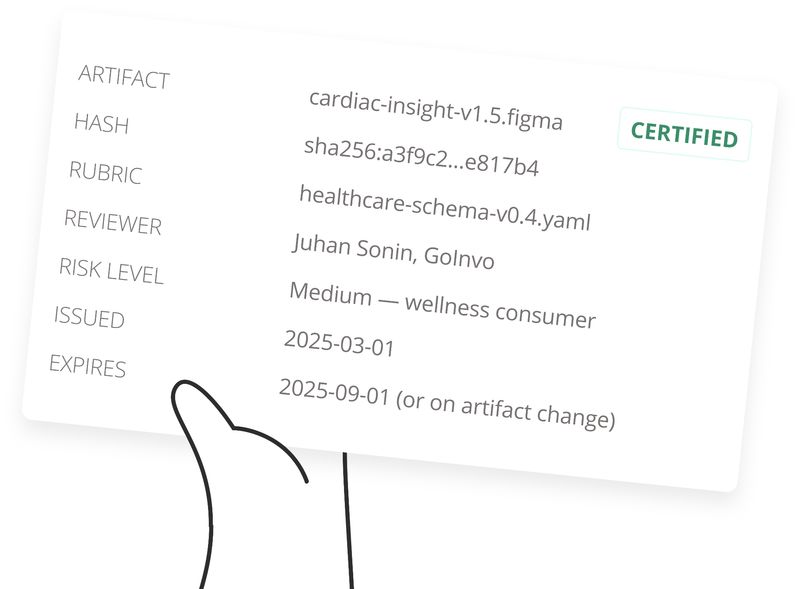
Any meaningful artifact change invalidates the certificate and triggers re-review, preventing silent regression after approval. This is not a one-time stamp — it is a living audit trail.
7. The point
Treat AI outputs as the medical devices at the UI layer.
You're not trusting an AI model.
You're certifying the health insight itself,
the thing a human actually sees,
so teams can move fast and stay safe.
How it works in your workflow
Certification lives where work happens. A "Request Certification" button embedded in GitHub pull requests, Figma, design systems, and CMSs. Certification as a button, not a process.
Risk-based gates scale thresholds with context: a marketing site and a clinical intake form are not the same artifact. Higher risk means stricter gates, named reviewers, and shorter certificate lifetimes.
We’re building this in the open:
If you’ve got a real or prototype healthcare product, let’s together run it through the cert so we can pressure-test it on reality.
Authors

Chloe Ma, GoInvo
Chloe is a designer and researcher specializing in medical and scientific storytelling. She drives to improve healthcare equity, education, and accessibility through good design. Chloe joined Invo in 2021 with a BS in BioChemistry and Molecular Biology from Dalhousie University and a MSc in Biomedical Communication from University of Toronto.

Juhan Sonin, GoInvo
Juhan Sonin leads GoInvo with expertise in healthcare design and system engineering. He’s spent time at Apple, the National Center for Supercomputing Applications (NCSA), and MITRE. His work has been recognized by the New York Times, BBC, and National Public Radio (NPR) and published in The Journal of Participatory Medicine and The Lancet. He currently lectures on design and engineering at MIT.
Contributors

Eric Benoit, GoInvo
Eric Benoit is the Creative Director of GoInvo, leading the studio’s UX creation process from concept to production. Eric works as an interaction designer, experience designer, and information architect, designing better products by thoroughly understanding user behaviors, expectations, and goals. Eric’s background and love for design in the context of human experience helps him transform complex information systems in healthcare and the enterprise into responsive and adaptive human-centered designs.
Special thanks to...
Mark Begale for gently tapping the AI Certification idea into our skulls, and to Venus Wong for volunteering as our first certification partner.
About GoInvo
GoInvo is a healthcare design company that crafts innovative digital and physical solutions. Our deep expertise in Health IT, Genomics, and Open Source health has delivered results for the National Institutes of Health, Walgreens, Mount Sinai, and Partners Healthcare.
Interested in digital healthcare strategy and user experience design?
Contact Us